


Gene Electroporator
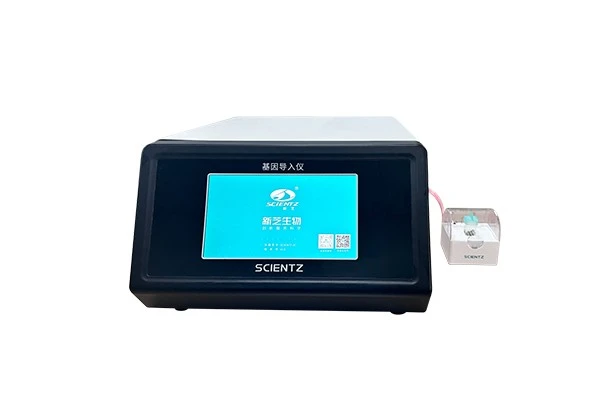
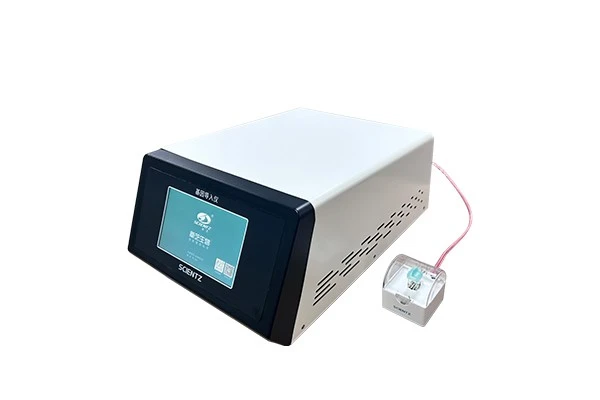
SCIENTZ-2CS Gene Electroporator
The SCIENTZ-2CS Gene Electroporator consists of the main unit, a gene electroporation cup and dedicated connecting cables. It uses electroporation to introduce DNA into competent cells, plant and animal cells, and yeast cells. Compared with other transformation methods, it offers high repeatability, high efficiency, ease of operation and precise control, and because electroporation is a physical rather than a chemical or viral process, it causes negligible genotoxicity.
Working Principle
Electroporation (cellular electroporation) introduces exogenous macromolecules – DNA, RNA, siRNA and proteins, as well as small molecules – into cells. Under a transient, strong electric field, the cell membrane becomes temporarily permeable, allowing charged exogenous substances to cross it in a manner similar to electrophoresis. Because the phospholipid bilayer has high resistance, most of the applied voltage is borne by the membrane itself, with minimal voltage reaching the cytoplasm; the voltage at the nuclear membrane is close to zero, which keeps genotoxicity negligible. Since the process is physical rather than chemical, the molecular properties of the cell surface have little effect on it, so the SCIENTZ-2CS can be applied to virtually any cell type and its results are easily quantifiable.
Features
- High efficiency – short transformation time, high conversion rate, small tolerance
- Intelligent storage – experimental parameters can be stored for future use
- Precise control – microprocessor-controlled pulse discharge
- Aesthetic, integrated design – intuitive touchscreen display, simple operation
Technical Parameters
- Pulse type: exponential decay
- High voltage output: 401–3000 V
- Low voltage output: 50–400 V
- High voltage capacitance: 10 / 25 / 35 / 50 / 60 µF
- Low voltage capacitance: 50–1560 µF, in 25 µF steps
- Parallel resistance: 50–1650 Ω, in 50 Ω steps
- Control system: microcomputer-controlled, with adjustable RC time constant
- Main unit dimensions: 40 × 30 × 20 cm; net weight 5.5 kg
Standard System Configuration
Main unit, gene electroporation cup, dedicated connecting cables.
Indicative Electroporation Parameters by Organism
| Organism | Pulse voltage (V) | Resistance (Ω) | Capacitance (µF) | Cup (mm) |
|---|---|---|---|---|
| E. coli | 1800 | 200 | 25 | 1 |
| E. coli | 2500 | 200 | 25 | 2 |
| E. coli | 3000 | 200 | 25 | 2 |
| A. tumefaciens | 2400 | 200 | 25 | 1 |
| P. aeruginosa | 2500 | 200 | 25 | 2 |
| S. aureus | 2900 | 100 | 25 | 2 |
| B. cereus | 1000 | 200 | 25 | 2 |
| S. pyogenes | 2100 | 200 | 50 | 2 |
| L. plantarum | 2000 | 400 | 25 | 2 |
| S. cerevisiae | 1500 | 200 | 25 | 2 |
| S. pombe | 2300 | 200 | 25 | 2 |
| C. albicans | 1500 | 200 | 25 | 2 |
| P. pastoris | 2000 | 200 | 25 | 2 |
Note: parameters vary between labs and are provided for reference only.
Applications of SCIENTZ-2CS Gene Electroporator
- Electroporation of bacteria, yeast and other microorganisms
- Transfection of mammalian cells, plant tissues and protoplasts
- Cell hybridisation and gene fusion
- Introduction of marker genes for labelling and indicating purposes
- Introduction of drugs, proteins, antibodies and other molecules for studying cellular structure and function
Typical fields of use include the food industry, agricultural sciences, veterinary research and bioengineering.
- Pulse type: exponential decay
- High voltage output: 401-3000V
- Low voltage output: 50-400V
- High voltage capacitance: 10/25/35/50/60 µF
- Low voltage capacitance: 50-1560 µF in 25 µF steps
- Parallel resistance: 50-1650Ω in 50Ω steps
- Control system: microcomputer control, adjustable RC time constant
- Main unit dimensions: 40x30x20cm
- Net weight: 5.5kg
- Packaging dimensions: 58x36x25cm


